Introduction: When the Requested Machine Is Not the Right Solution
When an Indian customer contacted us about purchasing a CNC surface grinding machine for ophthalmic surgical blade production, the inquiry initially appeared straightforward. The customer needed grinding equipment, and the next step seemed to be selecting a suitable machine and discussing its price.
However, after examining the application more carefully, we discovered that the real challenge was not choosing a machine from a catalog. It was identifying the correct manufacturing process for extremely small, precision surgical blades.
The project eventually developed into a broader technical discussion involving equipment selection, sample verification, tooling preparation, and pricing clarification.
Three important issues emerged during the process:
-
The requested CNC surface grinder did not match the intended blade-edge grinding operation.
-
The physical sample quantity differed significantly from the accompanying packing list.
-
A one-time tooling setup charge had been misunderstood as a per-blade processing cost.
Each issue could have created unnecessary expenses, production delays, or commercial disagreements.
By addressing these questions before proceeding, we helped redirect the discussion from equipment price alone toward a more practical manufacturing solution.
This case illustrates why precision grinding projects should begin with application analysis rather than machine quotations.
1. Understanding the Customer's Original Request
The customer was exploring equipment for manufacturing ophthalmic surgical blades in India.
Ophthalmic blades are specialized cutting instruments used in delicate eye surgery. Their manufacturing requirements differ significantly from those of ordinary industrial knives or general-purpose cutting tools.
Depending on the blade design, manufacturers must consider several critical factors:
-
Cutting-edge geometry and bevel angle
-
Edge consistency and symmetry
-
Burr formation and microscopic edge defects
-
Blade thickness and dimensional repeatability
-
Surface finish and edge integrity
-
Production stability across different blade models
A small variation in edge geometry may affect the consistency of the finished instrument.
For this reason, ophthalmic surgical blade manufacturing requires careful coordination between the grinding process, tooling design, workholding system, and inspection method.
The customer initially requested a CNC surface grinding machine.
Although CNC surface grinders are highly effective for producing flat surfaces, they are not automatically suitable for creating the precise cutting edges required by ophthalmic blades.
The customer's actual objective was to manufacture accurate and repeatable surgical blade edges, rather than simply grind a flat surface.
Recognizing this distinction changed the direction of the project.
2. Why a CNC Surface Grinder Was Not the Appropriate Choice
A CNC surface grinding machine is primarily designed for machining flat surfaces and maintaining dimensional accuracy.
Typical applications include precision plates, molds, machine components, and other workpieces requiring controlled flatness or thickness.
However, ophthalmic surgical blade edge grinding involves a different set of technical requirements.
A specialized blade-edge grinding machine can be configured to control the cutting-edge profile, grinding angle, workpiece positioning, and repeatability needed for particular blade designs.
Depending on the application, the system may incorporate dedicated fixtures, precision positioning mechanisms, suitable abrasive wheels, and specialized grinding programs.
In this Indian customer's case, the more appropriate solution was a dedicated blade-edge grinding machine rather than the originally requested CNC surface grinder.
This distinction matters commercially.
Purchasing the wrong machine can create several problems:
Unnecessary capital expenditure: A machine may satisfy the purchasing specification without delivering the required manufacturing result.
Additional process development: Engineers may need to design complicated fixtures or introduce secondary operations.
Inconsistent blade quality: An unsuitable process can make it difficult to maintain repeatable edge geometry.
Longer production preparation: Machine modifications and process corrections may delay the manufacturing schedule.
Rather than immediately quoting the requested equipment, the discussion shifted toward understanding the blade designs and their actual machining requirements.
The objective was to identify a technically appropriate process before the customer committed to an equipment investment.
3. The Importance of Application-Based Grinding Machine Selection
For medical blade manufacturers, selecting a grinding machine should begin with the finished product.
A supplier needs to understand what the machine must produce, how the workpiece will be positioned, and which quality requirements must be maintained.
For ophthalmic surgical blade grinding, several questions are especially important.
What type of ophthalmic blade will be manufactured?
Different blade geometries may require different grinding angles, fixtures, and wheel configurations.
A process developed for one blade profile may not be directly transferable to another.
What are the dimensional and edge-quality requirements?
The required edge geometry, thickness tolerance, surface condition, and inspection criteria determine the appropriate machining strategy.
How many blade models will be produced?
A production line manufacturing multiple blade designs may require different fixtures, setup procedures, and machine programs.
What is the expected production volume?
Small-batch development and high-volume manufacturing may justify different levels of automation and tooling investment.
How will the finished blades be inspected?
Grinding capability should be evaluated alongside the measurement and quality-control process.
These questions help manufacturers compare equipment based on practical suitability rather than purchase price alone.
For international customers, this application-based approach can also reduce misunderstandings between equipment suppliers, production engineers, and purchasing departments.
4. A Sample Verification Problem: 800 Pieces Listed, Only 349 Received
After the initial technical discussion, another important issue appeared during sample verification.
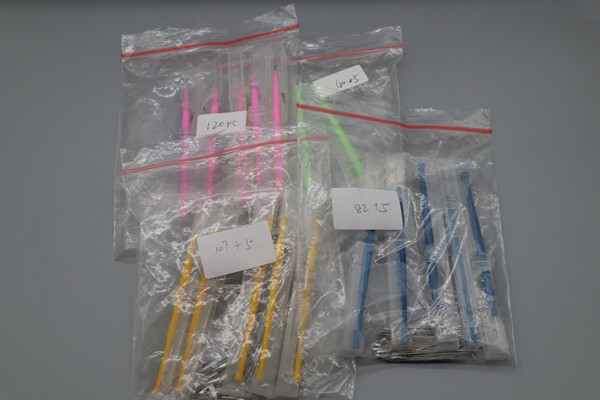
The accompanying packing list indicated that 800 blade samples had been shipped.
However, the actual physical count was significantly lower.
| Sample verification |
Quantity |
| Quantity on packing list |
800 pieces |
| Actual quantity received |
349 pieces |
| Quantity discrepancy |
451 pieces |
This was not a minor administrative detail.
The actual quantity represented less than half of the number stated on the packing list.
For a precision grinding project, sample quantities influence trial planning, tooling preparation, process validation, and production scheduling.
If the discrepancy had remained unnoticed, the project could have proceeded on incorrect assumptions.
For example, the planned sample allocation might have been insufficient for evaluating multiple blade designs or repeating grinding trials.
The discrepancy could also have caused confusion about which party was responsible for supplying additional samples.
By verifying the physical inventory before proceeding, the team identified a practical issue that needed clarification.
The broader lesson is simple: a packing list is a shipping document, not proof of the quantity actually received.
For custom grinding projects, sample verification should be completed before finalizing testing arrangements or production commitments.
5. Why Sample Counting Matters in Precision Grinding Projects
Sample verification is especially important when developing grinding processes for small, high-value components.
A manufacturer may need samples for initial setup, grinding trials, dimensional inspection, edge-quality evaluation, and process adjustments.
Not every sample will necessarily become a finished, acceptable product during development.
Consequently, the available sample quantity affects how the project can be organized.
A practical verification procedure should establish the actual quantity received, the number of different blade models, the condition of the samples, and any differences between physical inventory and shipping documentation.
The results should be communicated before testing begins.
This helps both parties establish realistic expectations and prevents avoidable disputes later.
For international projects, accurate sample documentation is also useful when coordinating suppliers, freight providers, engineering teams, and customers across different countries.
6. The Pricing Misunderstanding: Was USD 900 Really a Processing Charge?
The third issue was commercial rather than mechanical.
During the pricing discussion, the customer considered the quoted amount expensive.
At first glance, this could have led to a conventional negotiation focused on reducing the price.
However, further clarification revealed that the customer had misunderstood the basis of the charge.
The quoted amount was USD 900 for a one-time tooling and setup fee for each blade model.
It was not a processing fee charged for every batch of 200 blades.
The customer had interpreted the USD 900 amount as a processing charge for 200 pieces.
Under that interpretation:
USD 900 ÷ 200 pieces = USD 4.50 per blade.
The calculation itself was correct, but the underlying assumption was not.
The fee related to tooling preparation and setup for a blade design, rather than a confirmed variable processing cost of USD 4.50 for each blade.
This distinction fundamentally changes how a customer should evaluate the quotation.
7. Understanding Tooling Setup Costs Versus Unit Processing Costs
In precision manufacturing, quotations may include several different cost categories.
One-time tooling and setup costs can cover application-specific fixture preparation, machine programming, setup work, and other development activities, depending on the agreed scope.
Variable processing costs relate to manufacturing activities that change with production quantity.
Additional project costs may include inspection, testing, packaging, or other services when separately specified.
These categories should not be treated as interchangeable.
For example, a USD 900 setup fee allocated across an initial batch of 200 pieces represents USD 4.50 per piece in allocated setup cost.
However, if the same setup supports a larger production quantity without requiring the fee to be paid again, the allocated setup cost per piece becomes lower.
This does not establish the actual manufacturing cost per blade, because variable processing and other expenses must still be considered.
The important point is that the customer must understand what the quotation includes before comparing prices.
A seemingly expensive quotation may reflect a misunderstanding of the charging structure rather than an uncompetitive manufacturing process.
8. Why Technical Communication Can Be More Valuable Than a Discount
Price negotiations are common in international machinery and precision tooling projects.
However, reducing the quotation is not always the most effective response to a customer's concern.
In this case, the discussion revealed three underlying problems:
The originally requested machine did not match the application.
The received sample quantity differed from the documentation.
The customer had misunderstood the tooling setup charge.
None of these problems could be solved simply by offering a lower price.
Instead, they required technical explanation, inventory verification, and clearer commercial communication.
The discussion therefore moved beyond the original equipment quotation toward a more collaborative approach to the manufacturing process.
This is particularly relevant to customers developing new products or introducing unfamiliar manufacturing technologies.
A technically informed supplier can help identify requirements that may not be fully defined in the initial inquiry.
The value lies not only in supplying a machine or grinding tool, but also in helping the customer make a better-informed purchasing decision.
9. What Medical Blade Manufacturers Should Check Before Purchasing Grinding Equipment
Manufacturers considering a surgical blade grinding machine should evaluate the entire application before placing an order.
The starting point should be a drawing or detailed specification of the intended blade.
The supplier should then review the blade geometry, material, grinding requirements, expected production quantity, and inspection criteria.
If physical samples are provided, the received quantity and condition should be confirmed.
Any application-specific tooling or fixture charges should be clearly separated from recurring manufacturing costs.
Finally, both parties should agree on how process feasibility and finished-part quality will be evaluated.
This structured approach helps reduce the risk of purchasing unsuitable equipment or entering production with unclear expectations.
For ophthalmic surgical blades, the grinding process is only one part of the wider manufacturing and quality system. Finished medical instruments also require appropriate validation and compliance with applicable regulatory requirements.
10. Frequently Asked Questions About Ophthalmic Surgical Blade Grinding
What machine is used for ophthalmic surgical blade grinding?
A dedicated precision blade-edge grinding machine may be suitable, depending on the blade geometry, material, and production requirements. A conventional CNC surface grinder is not necessarily appropriate for the cutting-edge operation.
Can a CNC surface grinder manufacture surgical blades?
A CNC surface grinder can perform certain flat-surface operations, but specialized blade-edge grinding may require different equipment, fixtures, and process controls.
Why is custom tooling needed for surgical blade production?
Different blade designs may require dedicated workholding, setup procedures, or grinding programs to maintain consistent edge geometry.
How should manufacturers compare surgical blade grinding quotations?
They should distinguish one-time tooling charges from recurring processing costs and compare quotations using the same production quantity, technical scope, and quality requirements.
Why are physical samples important?
Samples allow engineers to assess the actual workpiece geometry and plan suitable grinding trials. Their quantity and condition should be verified before testing.
Conclusion: The Right Manufacturing Solution Begins With the Right Questions
This Indian ophthalmic surgical blade project began with a request for a CNC surface grinding machine.
A closer examination revealed that the application required a different grinding process, that the sample inventory needed clarification, and that the customer's pricing concern resulted from misunderstanding a one-time tooling charge.
The most important outcome was a change in the nature of the discussion.
Instead of focusing only on equipment price, the project developed into a technical conversation about how to manufacture the blades correctly.
For medical blade manufacturers, precision engineering companies, and industrial buyers, this case offers a valuable lesson:
Before negotiating the price of a grinding solution, make sure the machine, process, samples, and cost structure have been correctly understood.
Looking for a Precision Surgical Blade Grinding Solution?
More Super Hard works with international customers on precision grinding and abrasive tooling applications.
If you are evaluating equipment or grinding solutions for ophthalmic blades, medical cutting instruments, or other precision components, contact our team with your application requirements.
Share your blade drawings, material specifications, expected production volume, and quality requirements so that the appropriate grinding approach can be discussed.
Contact More Super Hard to discuss your precision grinding application.