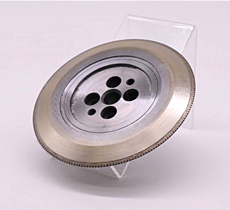
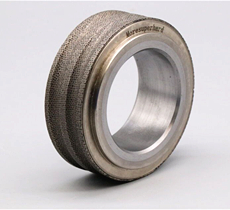
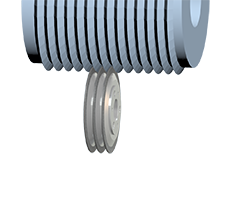
In the precision machining of molds, punches, carbide cutting tools, and complex curved components, optical curve grinders (also known as optical profile grinders or PG machines) play a critical role. Leveraging projection magnification and online monitoring, these machines achieve micron-level or even sub-micron contour accuracy. The optical curve grinding wheel is the core consumable, and its dressing quality directly determines workpiece contour accuracy, surface finish, productivity, and wheel life. Henan More SuperHard Products Co., Ltd. (MORESUPERHARD), with years of expertise in superabrasive tools, offers high-performance resin-bond and metal-bond diamond/CBN optical profile grinding wheels along with complete dressing solutions to help customers achieve stable, efficient, and high-precision form grinding.
Importance and Challenges of Dressing Optical Grinding Wheels
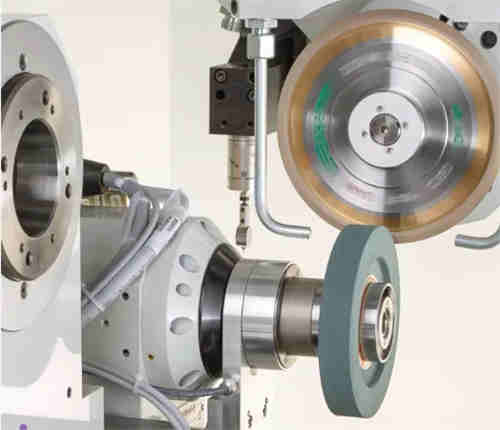
Optical grinding wheels typically use fine-grit diamond or CBN abrasives with resin or metal bonds, manufactured in shapes such as 3A1, 14K1, and 1B9 (thin-walled, sharp-angle, or complex profiles). They are compatible with mainstream machines including Amada, Waida, and Wasino. Key challenges include:
- High hardness of superabrasives leads to rapid tool wear and difficulty in machining contour accuracy with conventional dressing.
- Insufficient dressing increases grinding forces, causes burns and vibration marks; excessive dressing shortens wheel life and degrades initial surface quality.
- Complex curves, thin slots, and sharp angles demand extremely high geometric accuracy and proper grit protrusion height.
Dressing generally consists of truing (restoring geometry and concentricity) and dressing/sharpening (exposing sharp grits and creating chip space). For superabrasive wheels, these steps are usually performed separately to balance precision and cutting performance.
Mainstream Dressing Methods and Process Guidelines
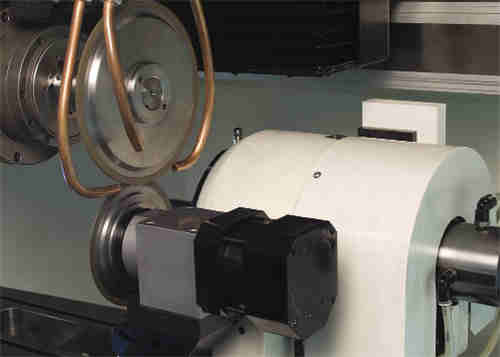
- Conventional Mechanical Dressing
- Single-point or multi-point diamond pen: Tilted 5°–15°, contact point 0.5–2 mm below wheel centerline, low-speed micro-feeds (finish depth <0.01 mm).
- Soft steel or oilstone: Soft steel enables simultaneous truing and dressing; WA/GC oilstones are effective for sharpening on surface grinders.
- Diamond rollers or cup wheels: Suitable for high-volume form dressing with good efficiency.
- Advanced Laser Dressing (Highly Recommended)
- Laser dressing is non-contact and tool-wear-free, ideal for precise truing and dressing of complex optical curve profiles. Typical parameters (nanosecond pulsed fiber laser, 1064 nm):
- Average power: 20–50 W (optimized example ≈35 W for dressing); higher for rough truing.
- Repetition rate: 50–200 kHz (commonly 100 kHz).
- Pulse width: 60–200 ns.
- Power density: ≥3×10⁸ W/cm² for diamond removal; controlled between bond and grit thresholds for bond-only removal.
- Wheel speed: 1–2 m/s or 200–500 r/min (optimized example 300 r/min).
- Scan/feed rate: ≈1.0 mm/min or axial feed 0.005 m/s.
- Spot overlap ratio: 20–50% in circumferential and track directions (optimized ≈30%).
Multi-stage strategy (high-energy rough truing + low-energy fine dressing + finishing), combined with CCD monitoring, achieves micron-level accuracy.
- Other Methods
- EDM dressing and ELID electrolytic dressing suit metal-bond wheels; optical form dressers with microscopes enable real-time monitoring of arcs and angles.
MORESUPERHARD Optical Grinding Wheel Solutions
MORESUPERHARD specializes in high-performance wheels for optical profile grinding:
- Product Features: Available in resin and metal bonds; models include 3A1, 14K1, 1B9, etc.; grit sizes from coarse to ultra-fine (140#–1000# and finer); customizable sharp angles, thin walls, specific angles, and radii.
- Compatible Machines: Amada, Waida, Wasino, and other mainstream optical profile grinders.
- Applications: Precision molds and punches, form grinding of carbide/ceramics, end mills and reamers, precision instrument parts. Diamond wheels for hard-brittle materials (carbide, ceramics, etc.); CBN wheels for heat-treated steels (SKH, SKD, etc.).
- Key Advantages: Excellent form retention and grit holding power ensure stable accuracy and long life after dressing. Combined with proper dressing processes, these wheels reduce changeover frequency and improve workpiece consistency. Custom formulas and geometries are available based on specific contour requirements, supported by technical advice.
By selecting MORESUPERHARD optical curve grinding wheels and applying a strategy of “micro-feeds in multiple passes, real-time monitoring, and multi-stage laser/mechanical hybrid dressing,” customers can achieve:
- Stable micron-level contour accuracy;
- Balanced surface quality and cutting performance;
- Effective reduction in overall production costs.
Recommendations
- Perform static/dynamic balancing before dressing to minimize runout.
- Prioritize optical projection or CCD online monitoring to avoid over-dressing.
- Ensure adequate coolant to prevent thermal damage and loading.
- Adjust parameters according to bond type, grit size, and profile complexity; conduct small-area trials when necessary.
- Regularly inspect and maintain dressing tools for sharpness.
MORESUPERHARD is committed to providing one-stop solutions covering wheel selection, customization, and dressing process optimization. Contact us for product details, technical support, or customized services to jointly enhance the precision and efficiency of optical curve grinding.