NEWS
13
Oct

Why Custom PCBN Inserts Are Replacing Grinding

Share:

Robotics Is Raising the Bar for Ball Screws


When people think about robots, they picture servo motors, gear reducers, controllers, and robotic arms. But motor power does not become linear motion by itself—something has to transfer that power into precise, repeatable movement. For equipment that needs high-accuracy linear motion, the ball screw is that component: it converts rotation into stable, accurate linear displacement. As industrial robots, automation cells, and humanoid joints push positioning accuracy, repeatability, and motion stability ever higher, those demands flow upstream into ball-screw manufacturing itself. The robot boom is not just increasing demand for screws—it is driving the precision-screw supply chain to upgrade its machining process.


What Changed: From "Can We Make It?" to "Can We Make It Consistently?"


Ball screws are not new. They have been the backbone of CNC machine tools, automation, and precision motion for decades. What changed is the market’s expectation. A decade ago customers asked: can this part be produced at all? Today they ask: can it be produced consistently? Can accuracy hold batch after batch? How tight is the run-to-run uniformity? Can cycle time be cut? All of these questions land on the machining process—especially post-heat-treatment machining. Ball-screw shafts and raceways are quenched and tempered to around HRC 60–62, which makes raceway grinding and finishing one of the most difficult steps in the whole line.


Why "Turn Instead of Grind" Is Gaining Ground


Final precision on a ball screw does not appear in one magical finishing step—it accumulates from material selection, heat treatment, roughing, semi-finishing, and finishing. Simply speeding up one step rarely improves overall throughput; optimizing the whole route does. That is why "turn instead of grind" (hard turning with PCBN inserts on heat-treated stock) is gaining traction. For suitable ball-screw applications, PCBN hard turning can take over part of the finishing work, reduce the number of grinding passes, and improve overall cycle time. Literature consistently lists hard turning as a key direction for ball-screw manufacturing—though whether it fits a given workpiece depends on material, hardness, stock allowance, raceway profile, and machine condition.


Why a Standard PCBN Insert Will Not Cut It on a Ball Screw


Here is the practical issue. Ordinary hard turning and ball-screw raceway turning both use PCBN—but they cannot use the same insert. A ball screw machines a specific raceway profile (arc forms for recirculating balls, multi-start thread forms for roller screws). The cutting edge must be designed around that profile. Buying a standard PCBN insert off the shelf and hoping it matches your raceway is a recipe for profile error, surface defects, and premature edge failure. What screw manufacturers actually need is not "the highest-grade insert"—it is an insert whose edge geometry matches the raceway, whose substrate matches the workpiece hardness, and whose setup matches the machine and fixturing.

Approach Standard PCBN Insert Custom Raceway-Profiled PCBN Tool
Edge geometry Generic ISO form; does not match raceway Cutting edge ground to your exact raceway profile
Profile accuracy Depends on setup; often needs trial and error Right-first-time form; repeatable batch after batch
Best use case Simple external hard turning, general shafts Ball screw raceways, roller screw threads, precision transmission parts
Process role Stand-alone cutting edge Part of the whole machining route (with toolholder and strategy)


Two Custom PCBN Solutions for Heat-Treated Ball Screws


MoreSuperHard supplies two custom PCBN tooling families for heat-treated ball screws, matched to the machining route:
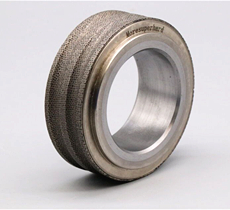
  • PCBN hard-turning inserts: custom-ground to the raceway profile and mounted on matched turning toolholders for lathe or turning-center finishing of HRC 60–62 screw shafts.
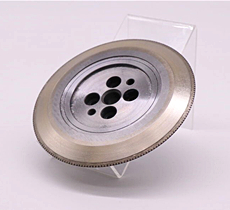
  • PCBN whirlwind-milling inserts: a carbide body with PCBN inserts, edge-profiled to the raceway, for high-speed thread and raceway whirling where grinding passes are being reduced.
In both cases, the tool is designed from the workpiece outward: screw drawing, material, heat-treated hardness, raceway profile, stock allowance, and current process. The customer does not buy an isolated insert—they buy a tool that matches the workpiece and the process.


A Practical Example: Reducing Grinding Passes on HRC 60 Screw Shafts


Consider a precision screw shop producing raceways on HRC 60–62 shafts. The traditional route is hard turning followed by multiple grinding passes to hit profile and surface finish. With a raceway-profiled PCBN insert on a rigid CNC lathe, many shops find they can semi-finish the raceway to near-net shape in one hard-turning pass, leaving only a light finish grind. The result is fewer grinding hours per part, less wheel-dressing downtime, and a more stable process—because PCBN edge wear is predictable compared with grinding-wheel drift. The exact split between turning and grinding depends on raceway profile depth, stock allowance, surface-finish target, and machine rigidity, but the direction is consistent across the industry.
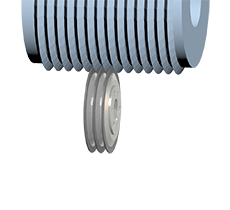
Whirlwind milling extends this logic to thread forms. A rotating carbide body with profiled PCBN inserts cuts the thread or raceway form at high speed, often replacing thread grinding for medium-volume production. Because the tool body is carbide and the inserts are indexable, shops can regrind or replace worn PCBN edges without scrapping the whole cutter—an important cost factor when raceway profiles are complex.


The Bigger Shift: Tooling as Part of the Process


Ball screws are one segment of a larger wave. Robotics, automation, precision machine tools, and humanoid actuators all demand more stable, more accurate, and more efficient motion in tighter spaces. Screw manufacturers must continuously improve material, heat treatment, machining accuracy, cycle time, and batch consistency. Tool suppliers must change with them. Customers increasingly expect their tooling partner to understand: what is the workpiece? Where is the hardest machined feature? Why is the current route chosen? Can the route be optimized? For high-end transmission parts, "harder" and "more wear-resistant" alone are not enough—a PCBN grade with the right substrate but a mismatched edge profile still fails. The purchasing question has shifted from "which insert performs best?" to "which tool best fits my workpiece and my process?"


How to Start


If you are evaluating hard turning or whirlwind milling for heat-treated ball screws, do not start by comparing standard PCBN inserts from different brands. Start with the actual workpiece. Send us the screw drawing, material, heat-treatment hardness, raceway profile, stock allowance, and your current process. We will assess whether hard turning can replace or reduce grinding passes, design the raceway-profiled PCBN insert (or whirlwind cutter) to match, and support trial production. Precision transmission competition is ultimately decided on manufacturing detail—and the tool is no longer a disposable consumable. It is part of the process.


Frequently Asked Questions


Q: Can PCBN hard turning replace grinding on ball screws?
A: For many heat-treated ball screws at HRC 60–62, custom-profiled PCBN hard turning can replace or reduce finishing grinding passes, improving cycle time. Whether it fits depends on material, hardness, stock, raceway profile, and machine condition—process trials are recommended.

Q: Why not just use a standard PCBN insert for ball screw raceways?

A: Because the raceway has a specific arc or multi-start profile. A generic ISO insert does not match that geometry, leading to profile error and poor surface finish. The cutting edge must be ground to the raceway contour.

Q: What is whirlwind milling for ball screws?

A: Whirlwind (or thread whirling) uses a rotating carbide body with PCBN inserts profiled to the raceway to cut or semi-finish thread forms in hardened stock. It is an efficient alternative to grinding for certain screw geometries.

Q: What hardness are ball screw raceways?

A: Typically HRC 60–62 after quenching and tempering. This is well beyond the range of carbide and ceramic cutting tools; PCBN is the standard cutting material for hard turning.

Q: What information do you need to quote a custom PCBN tool?

A: Screw drawing, material grade, heat-treated hardness, raceway profile and dimensions, stock allowance, current process (turning, grinding, whirling), and machine/toolholder details.

Q: How does robotics demand change ball screw machining?

A: Robotics pushes accuracy, repeatability, and batch consistency higher—turning the market from "can we make it?" to "can we make it consistently and fast?" This drives investment in custom PCBN tooling, process optimization, and replacing grinding with hard turning where possible.
 
FOLLOW US
This Blog keeps our valued customers informed of important Radiac News and Events, and in the industries we serve.
Copyright © 2003-2023 More SuperHard Products Co., Ltd
Home
Whatsapp
E-mail
Inquiry