NEWS
13
Oct

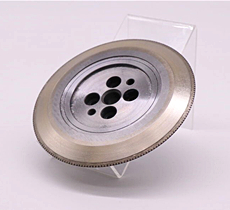
Double Disc Grinding Wheels

Share:

What Is Double Disc Grinding?


Double disc (or double-side, double-end-face, dual-disc) grinding is a high-precision process in which a flat component passes between two opposing grinding wheels—an upper and a lower disc—so that both parallel faces are ground simultaneously. It is one of the most productive ways to achieve tight flatness, parallelism, and thickness tolerance on flat parts: brake discs, bearing rings, connecting rods, piston rings, valve plates, shims, ceramic substrates, silicon wafers, and carbide inserts. The quality of the finished faces depends almost entirely on the grinding discs themselves—and choosing the right disc is where most shops either save money or lose it.


Choose the Abrasive: CBN for Metals, Diamond for Hard-Brittle Materials


The first decision is abrasive. Two superabrasives dominate high-end double disc grinding, and conventional abrasives still have a place for general metal work:

Abrasive Best Workpiece Materials Typical Applications
CBN (cubic boron nitride) Hardened steel, alloy steel, bearing steel, high-carbon steel Brake discs, bearing rings, piston rings, connecting rods, rotors/stators, shims, steel washers
Diamond Hard, brittle non-metals and non-ferrous metals Ceramic valves/substrates, silicon wafers, carbide inserts, magnetic materials, glass, stone
Resin / vitrified aluminum oxide General unhardened steels, mild stock removal Roughing low-cost parts where superabrasive is not justified
Silicon carbide Cast iron, non-ferrous alloys, brittle metals Cast-iron brake rotors, aluminum components

A simple rule of thumb: if the workpiece is ferrous and hardened to above HRC 45, use CBN. If it is ceramic, silicon, carbide, glass, or stone, use diamond. Resin-bond discs provide a smooth finish and gentle action; vitrified-bond discs run cooler, allow higher stock removal, and hold form longer in production.


Applications: Where Double Disc Discs Earn Their Keep


Automotive and general metal parts (CBN discs are the standard):
  • Brake discs and brake rotors (both faces ground in one pass).
  • Piston rings, cylinder liners, and valve seats.
  • Connecting rods, steering-pump rotors and stators, vane-compressor rotors.
  • Shims, washers, precision spring end faces, bearing faces on cylinder blocks.
Hard-brittle and electronic materials (diamond discs dominate):
  • Ceramic valve cores, ceramic valve plates, and ceramic substrates.
  • Monocrystalline silicon wafers and semiconductor substrates—both sides lapped to sub-micron flatness.
  • Carbide inserts and tool blanks.
  • Magnetic materials, ferrite cores, and engineered stone surfaces.


Machine Compatibility: Replacement Discs for Common Double Disc Grinders


A major purchasing habit in industrial abrasives is to search for "my machine brand + grinding disc"—because replacement discs must fit the spindle, mounting flange, diameter range, and arbor pattern of the existing machine. Common double disc grinder lines include Gardner, Peter Wolters, Lapmaster, Diskus, Giustina, Speedfam, Koyo, and AMADA WASINO. Whether your machine is thru-feed (parts pass straight through) or rotary-feed (parts travel in a circular carrier), the disc dimensions, hole pattern, and mounting flange must be matched. We supply replacement CBN and diamond double-side discs for these machine families—with custom OEM disc production up to 1200 mm and even 1500 mm diameter for heavy-duty applications.

Machine Style Typical Disc Type Key Requirement
Thru-feed double disc grinder Segments or full-ring CBN/diamond discs Disc opening and segment pattern must match carrier fixturing
Rotary-feed double disc grinder Full-ring resin or vitrified discs Concentric mounting and runout control
Lapping machine (Peter Wolters, Lapmaster, Speedfam) Fine-grit diamond/CBN lapping plates Sub-micron flatness, long lapping life
Heavy-duty production line Large-diameter vitrified CBN discs (up to 1500 mm) Rigid mounting, high stock-removal rate


Why Disc Dressing Determines Your Cost-per-Part


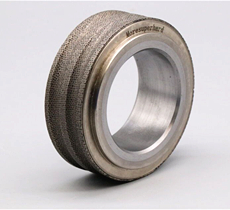
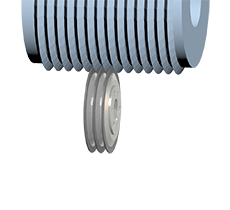
Double disc grinding is high-production by nature—parts pass between the wheels continuously—so even small drift in disc geometry shows up across thousands of parts. The dressing cycle is what keeps the disc face flat, open, and concentric. A disc that is dressed too aggressively sheds abrasive quickly and shortens disc life; a disc that is dressed too little loads up, burns the surface, and produces out-of-flat parts. The best double disc lines pair the right CBN or diamond disc with a matched diamond dressing roll and a controlled dressing interval. Shops that treat dressing as an afterthought pay for it in scrap, wheel cost, and lost machine time. When you specify a new disc, ask the supplier how it should be dressed, at what interval, and with which dresser—that information is worth as much as the disc itself.


Cost-per-Part: Why "Cheaper Disc" Rarely Wins


Double disc buyers commonly compare disc price per piece—but that is the wrong unit. The right benchmark is cost per finished face. A slightly more expensive CBN disc that holds flatness across twice as many parts, dresses half as often, and reduces scrap by a few percent will almost always beat the lower-priced disc over a year. The same logic applies to diamond lapping plates for semiconductor and ceramic work: a long-life plate that runs for months between replacements outperforms a cheap plate that needs re-dressing every week. When you request a quote, give the supplier your expected volume and target disc life—they can help you calculate the real cost per part rather than just disc price.


Technical Specifications That Matter

 
  • Flatness and parallelism target: high-precision discs hold sub-micron flatness and parallelism.
  • Grit size: coarse grits (46#–120#) for stock removal; medium (180#–400#) for finishing; fine (600# and above) for lapping and mirror faces.
  • Bond type: resin for fine finish and gentle action; vitrified for high stock removal and long life; metal bond for heavy-duty and continuous dress.
  • Disc diameter: standard sizes up to 1200 mm; custom OEM discs up to 1500 mm for large production lines.
  • Dressing compatibility: the disc must be dressable with the diamond dressing roll or dressing station already on the machine.


Large-Diameter and Custom Discs


Some production lines run discs far larger than standard stock—up to 1200 mm, 1500 mm, or beyond for heavy-duty automotive and bearing lines. These discs cannot be bought off the shelf; they require custom OEM manufacturing with segment geometry, mounting flange, and hole pattern matched exactly to the machine. Custom CBN and diamond discs at this size demand rigid production facilities and careful quality control, because any imbalance or runout at 1.5 meters diameter translates directly into vibration and out-of-flat parts. If your line uses large custom discs, choose a supplier that has built this size before and can provide runout, balance, and form inspection reports with every disc.


Buyer’s Checklist: What to Send for a Quote

 
  1. Machine brand and model (e.g., Gardner, Peter Wolters, Diskus, Lapmaster).
  2. Workpiece material and hardness (e.g., bearing steel HRC 60, ceramic, silicon wafer).
  3. Disc diameter, thickness, bore, hole pattern, and mounting drawings.
  4. Flatness, parallelism, and Ra targets.
  5. Thru-feed or rotary-feed setup; expected stock removal per pass.
  6. Wet or dry grinding; coolant type.
  7. Volume and target cost per part.


Why Choose Our Double Disc Grinding Discs


We manufacture CBN and diamond double-side grinding discs and lapping plates for automotive parts, bearing rings, piston rings, connecting rods, ceramic components, silicon wafers, and carbide inserts. Discs are available in resin and vitrified bonds, with custom grit, concentration, and geometry up to 1500 mm diameter, and are engineered as replacement parts for Gardner, Peter Wolters, Lapmaster, Diskus, Giustina, Speedfam, Koyo, and AMADA WASINO machines. Send us your machine brand, workpiece material, and target specs—we will recommend the right abrasive, bond, and disc geometry.


Frequently Asked Questions


Q: What is the difference between double disc and surface grinding?
A: Double disc grinding grinds both parallel faces of a part simultaneously between two opposing wheels, giving tight parallelism and high throughput. Surface grinding grinds one face at a time on a single wheel and is slower for two-sided parts.

Q: CBN or diamond for double disc grinding?

A: Use CBN for hardened ferrous parts—bearing rings, brake discs, piston rings, connecting rods. Use diamond for hard-brittle non-metals—ceramics, silicon wafers, carbide, magnetic materials.

Q: Can you supply replacement wheels for my double disc grinder?

A: Yes. We supply replacement CBN and diamond double-side discs and lapping plates for Gardner, Peter Wolters, Lapmaster, Diskus, Giustina, Speedfam, Koyo, AMADA WASINO, and similar machines—with custom diameters up to 1500 mm.

Q: What size double disc is standard?

A: Disc diameters range from a few hundred millimeters for lapping machines up to 1200 mm standard and 1500 mm custom for heavy-duty production lines. Exact diameter depends on the machine model.

Q: Resin or vitrified bond for double disc grinding?

A: Resin bond gives a smoother finish and gentler action, ideal for finishing and lapping. Vitrified bond runs cooler, removes stock faster, and holds form longer in high-volume production.

Q: What flatness can double disc grinding achieve?

A: With the right CBN or diamond disc and machine setup, double disc grinding achieves sub-micron flatness and parallelism on precision parts—typical for bearing rings, ceramic substrates, and semiconductor wafers.
 
FOLLOW US
This Blog keeps our valued customers informed of important Radiac News and Events, and in the industries we serve.
Copyright © 2003-2023 More SuperHard Products Co., Ltd
Home
Whatsapp
E-mail
Inquiry