NEWS
03
Sep

Grinding Wheels & Diamond Rollers for RV Reducer Precision Machining

Share:

What Is an RV Reducer and Why Does Precision Grinding Matter?


An RV (Rotate Vector) reducer is a high-precision gearbox used in industrial robot joints, CNC rotary tables, and automation equipment. Known for exceptional rigidity, near-zero backlash, and high torque density, it determines a robot's positioning accuracy and service life. Its core parts—the cycloidal gear, pin gear housing, and eccentric shaft—require tooth profile accuracy and surface finish measured in microns. After carburizing and quenching, these parts reach HRC 58–62, making them extremely difficult to machine with conventional abrasives. Precision grinding is therefore the decisive process that determines an RV reducer's transmission accuracy, noise, and operational lifespan.

Key RV Reducer Components and Grinding Challenges


Three components dominate the grinding workload, each with distinct challenges:
  • Cycloidal Gear: Features a complex epitrochoidal profile meshing with needle rollers. Profile error directly causes transmission error and vibration. Requires form or generating grinding with micron-level accuracy.
  • Pin Gear Housing: Contains semi-circular needle roller grooves around the inner circumference. Each groove must be consistent in diameter, position, and finish. Dedicated profile wheels plunge-grind each groove in one pass.
  • Eccentric Shaft: Drives the cycloidal gear via eccentric motion. Requires cylindrical, end-face, and internal grinding with tight concentricity tolerances.
The primary challenge is thermal: HRC 58–62 carburized steel generates high grinding temperatures causing workpiece burn, thermal cracks, and residual stress. Conventional aluminum oxide wheels wear rapidly, lose profile accuracy, and need frequent dressing, making it hard to balance efficiency, precision, and surface integrity in mass production.

Grinding Processes for RV Reducer Components


Two grinding technologies dominate RV reducer manufacturing:
  1. Form Grinding (Profile Grinding): A precision-dressed grinding wheel with the inverse tooth profile plunges into the workpiece to generate the form in one operation. Used for cycloidal gear teeth and pin housing grooves. Requires high-accuracy diamond rollers to maintain wheel profile.
  2. Generating Grinding (Continuous Gear Grinding): A worm-shaped grinding wheel meshes with the workpiece like a gear pair, continuously generating the tooth flank. Used for small-to-medium modulus gears and reducer-related tooth surfaces. Delivers high stock removal rates and excellent surface finish on machines such as KAPP and Gleason.

Grinding Wheel Solutions for RV Reducer Machining

 
                                RV Reducer Precision Machining

1. CBN & Diamond Profile Grinding Wheels

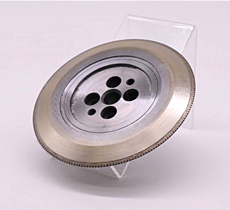
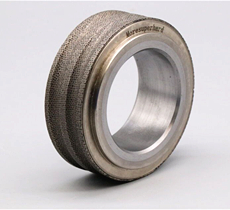
Electroplated CBN profile wheels are preferred for pin housing grooves and cycloidal gear grinding. The single-layer electroplated bond holds CBN grains securely while maintaining exact profile without frequent dressing—accuracy reaches the single-micron range. For higher stock removal and longer life, resin, metal, and vitrified (ceramic) bond CBN wheels offer self-sharpening behavior, cool cutting, and superior surface quality. Vitrified CBN wheels can be dressed with diamond rollers to restore profile accuracy, making them ideal for high-volume cycloidal gear grinding.

2. Worm Grinding Wheels & Gear Grinding Wheels

High-performance vitrified abrasive or CBN worm wheels are designed for continuous generating grinding on KAPP, Gleason, and equivalent CNC gear grinders. They deliver low grinding forces, excellent tooth profile retention, and high removal rates for small-to-medium modulus gears and reducer tooth flank finishing. The worm wheel's thread profile is precisely dressed with a diamond roller before each batch, ensuring consistent gear quality across thousands of parts.

3. Complementary Cylindrical, Surface & Internal Grinding Wheels

CBN and conventional wheels cover secondary operations on eccentric shafts and housings: cylindrical grinding of journals, end-face grinding, and internal grinding of bearing bores. These wheels maintain tight roundness (≤2 µm) and concentricity while minimizing thermal damage to hardened steel.


                                         RV Reducer Precision Machining


Comparison of Grinding Wheel Types for RV Reducer Components:
Wheel Type Best For Key Advantage Bond Options
Electroplated CBN Profile Pin housing grooves, cycloidal teeth No dressing needed, micron profile accuracy Electroplated (single-layer)
Vitrified CBN Profile High-volume cycloidal gear grinding Dressable, long life, cool cutting Vitrified (ceramic)
Resin/Metal CBN Rough & finish grinding of hardened steel Self-sharpening, high removal rate Resin, metal, hybrid
Worm Grinding Wheel Continuous generating gear grinding High throughput, excellent flank finish Vitrified abrasive or CBN

Diamond Rotary Dressers (Diamond Rollers) for Wheel Profiling


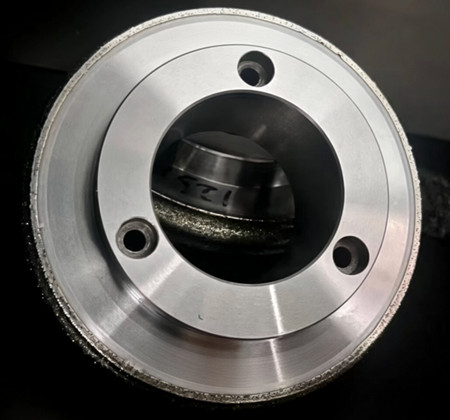
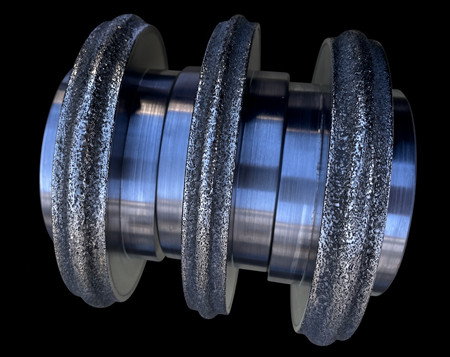
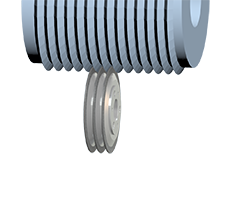
A diamond rotary dresser—also called a diamond roller—is a precision tool embedded with industrial diamonds that rotates against the grinding wheel to transfer a complex profile in seconds. For RV reducer manufacturing, diamond rollers are indispensable because they dress intricate cycloidal gear profiles and pin housing groove forms into CBN or conventional wheels with sub-micron repeatability. Manufactured via electroplating, sintering, or CVD diamond deposition, they offer exceptional profile retention and long service life—critical in mass production where dressing consistency determines part-to-part quality. Compared to single-point dressing, rotary rollers reduce dressing time by 80–90% and produce more uniform wheel surfaces.

How to Choose the Right Grinding Wheel and Diamond Roller


Evaluate these five factors when selecting tools for RV reducer grinding:
  1. Component & Profile: Cycloidal gear teeth → vitrified CBN profile wheel + diamond roller; pin housing grooves → electroplated CBN profile wheel; eccentric shafts → CBN cylindrical wheels.
  2. Machine Type: KAPP/Gleason generating grinders → worm wheels; dedicated CNC form grinders → profile wheels; universal grinders → standard CBN wheels.
  3. Production Volume: High-volume (>10,000 parts/month) → dressable vitrified CBN + diamond roller; low-volume/prototyping → electroplated CBN (no dressing needed).
  4. Material & Hardness: HRC 58–62 carburized steel → CBN is mandatory; softer materials (<HRC 45) → conventional aluminum oxide may suffice.
  5. Surface Finish Target: Ra < 0.5 µm → fine-grit vitrified CBN with gentle dressing; Ra 0.5–1.0 µm → medium-grit resin or metal bond CBN.

Benefits of CBN & Diamond Tools for RV Reducer Grinding


Switching from conventional aluminum oxide to CBN and diamond tooling delivers measurable improvements:
  • Wheel life extended by 5–20x, reducing changeover downtime and inventory cost.
  • Grinding cycle time reduced by 30–50% due to higher removal rates and fewer dressing cycles.
  • Surface roughness consistently below Ra 0.5 µm, as low as Ra 0.2 µm with optimized parameters.
  • Minimal thermal damage: CBN's high thermal conductivity (4x aluminum oxide) dissipates heat, preventing workpiece burn and cracks.
  • Profile accuracy maintained within ±2 µm across batches, and total grinding cost reduced by 20–40% despite higher upfront tool cost.

Best Practices for RV Reducer Precision Grinding

 
  1. Use high-pressure, filtered coolant (≤10 µm) at 20–40 L/min to control temperature and flush chips.
  2. Dress CBN wheels with diamond rollers at 0.005–0.01 mm depth and 0.5–1.0 roller-to-wheel speed ratio.
  3. Monitor spindle power (current) as a real-time indicator of wheel dulling and dressing need.
  4. Validate tooth profile with a gear measuring center after every wheel change and dressing.
  5. Maintain consistent workpiece temperature (20 ± 1°C) and document all parameters for ISO 9001 / IATF 16949 validation.

Why Choose MORESUPERHARD for RV Reducer Grinding Solutions


MORESUPERHARD is a professional manufacturer of diamond and CBN superabrasive tools, offering complete grinding wheel and diamond roller solutions for RV reducer core components. We customize wheel formulation, bond type (electroplated, resin, metal, vitrified, hybrid), dimensions, and diamond roller profile to match your CNC machines, workpiece materials, and accuracy requirements. Our application engineers provide end-to-end process support—from wheel selection and dressing parameter optimization to on-site troubleshooting—helping robotics and precision transmission manufacturers achieve higher accuracy, longer tool life, and lower production cost.

Conclusion

Precision grinding is the make-or-break process in RV reducer manufacturing, directly determining transmission accuracy, noise, and service life. CBN grinding wheels—electroplated profile, vitrified dressable, or worm-type—deliver the cool cutting, long life, and micron-level accuracy required for HRC 58–62 carburized steel. Diamond rotary rollers ensure complex cycloidal and pin housing profiles are reproduced consistently across mass production. By selecting the right CBN wheel and diamond roller combination and following validated practices, manufacturers can achieve Ra < 0.5 µm finish, ±2 µm profile accuracy, and 20–40% lower grinding cost—meeting the growing demand for high-precision RV reducers in industrial robotics and automation.
 
FOLLOW US
This Blog keeps our valued customers informed of important Radiac News and Events, and in the industries we serve.
Copyright © 2003-2023 More SuperHard Products Co., Ltd
Home
Whatsapp
E-mail
Inquiry